Product Description
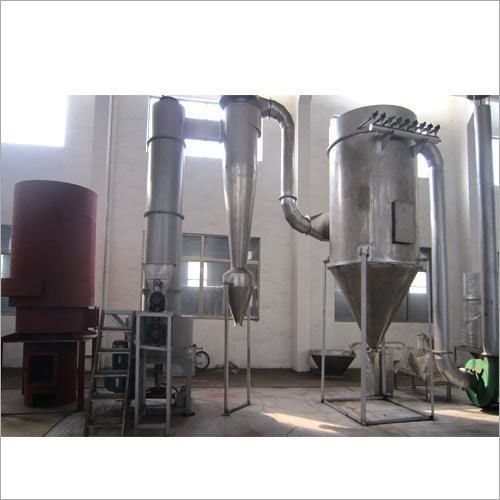
With the aim to serve our valued clients with a high quality range of product, we are engaged in manufacturing a wide range of Spin Flash Dryers. These dryers are designed and developed using high quality raw materials in adherence with the industry set quality parameters. We are providing our range of Spin Flash Drying Machines in various customized specifications and designs as per the need of our clients. These are thoroughly tested by our quality experts team to ensure their defect free nature which are available at most reasonable rates.
Features Of Spin Flash Drying Machine:
- Robust in construction
- Fine finish
- Long service life
- Robust design
Spin Flash Dryers Technical Details:
- Gross Power : 3 KW
- Voltage : 110 v - 220 v
- Weight : 38 kg
- Design : Standard, Customized
- Grade : Automatic, Semi-Automatic
- Material : Stainless Steel
- Max Temperature : 450 Degree C
- Frequency : 50 Hz
- Drying Chamber Size : 200 to 1600 mm
Our Spin Flash Dryers are designed for optimal drying performance across a wide capacity range. Employing direct hot air contact with centrifugal functionality, these dryers quickly process different feed consistencies, converting slurries, pastes, or cakes into fine powders. The vertical cylindrical design enhances drying uniformity, making the system suitable for intricate applications in pharmaceuticals, chemicals, and beyond.
Customizable Design Meets Industrial DemandsCrafted according to specific process requirements, each Spin Flash Dryer features adjustable dimensions, end connections, and discharge mechanisms. Choose between stainless steel or mild steel construction based on your materials and compliance needs. Fuel versatilitycoal, oil, gas, or electricityempowers seamless integration across diverse operational settings.
FAQs of Spin Flash Dryers:
Q: How does a Spin Flash Dryer achieve rapid moisture evaporation?
A: The Spin Flash Dryer uses a combination of centrifugal force and direct hot air contact to accelerate moisture removal. Products enter the vertical cylindrical drying chamber, where they are dispersed and immediately exposed to hot air streams, resulting in fast and efficient drying down to a fine powder.
Q: What types of materials can be processed in these Spin Flash Dryers?
A: These dryers are engineered to handle a wide variety of materials, including pharmaceuticals, chemicals, food products, dye stuffs, ceramics, pigments, and inorganic salts. The system efficiently dries feed in the form of cakes, pastes, or slurries, producing uniform, fine powders.
Q: When is it recommended to use a Spin Flash Dryer over other drying technologies?
A: A Spin Flash Dryer is ideal when you require rapid drying of heat-sensitive or sticky feed with high moisture content, such as in pharmaceuticals or pigments. Its ability to handle varied feed forms and deliver consistent, fine powders makes it particularly suitable for industries needing precise drying results.
Q: Where can Spin Flash Dryers be installed and what are the infrastructure requirements?
A: Spin Flash Dryers are suitable for installation in industrial settings across the pharmaceutical, chemical, food, dye, ceramics, and pigment industries. They require access to compatible power supply (220V, 380V, or 415V), a suitable heat source, and adequate space for operation, all tailored as per custom specifications.
Q: What is the process flow within the Spin Flash Dryer system?
A: Feed material (in the form of cake, paste, or slurry) is fed into the drying chamber, where its dispersed via a rotary mechanism. Hot airheated by steam, thermic fluid, or direct firerapidly dries the particles. The dried powder is then collected via a discharge mechanism, such as a rotary valve or screw discharge.
Q: How can users benefit from automated operation and customized air flow in Spin Flash Dryers?
A: Automated controls in the Spin Flash Dryer ensure consistent product quality and reduced labor involvement. Optimized air flow rates, tailored to each product and design, maximize drying efficiency, minimize energy consumption, and support high-throughput industrial processes.








 English
 Spanish
 French
 German
 Italian
 Chinese (Simplified)
 Japanese
 Korean
 Arabic
 Portuguese


 Send Inquiry
 Send Inquiry
 Send SMS
 Call Me Free


