Product Description
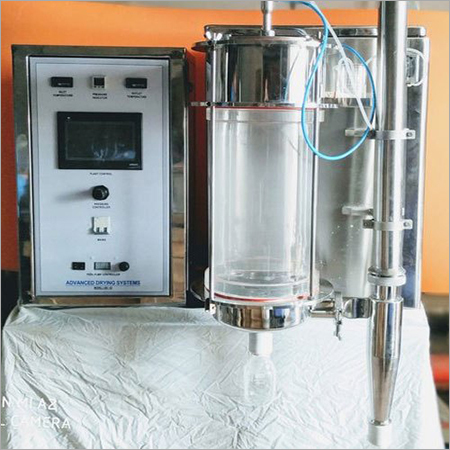
We are supplying here the LSD 02 Laboratory Spray Dryers for use in the various industrial and commercial applications. The offered dryers are easy to install and are useful for many situations and testing requirements, including feed formulation studies, producing samples for testing, and determining optimum drying conditions. The spray drying is a method of producing a dry powder from a liquid or slurry by rapidly drying with a hot gas. This is the preferred method of drying of many thermally-sensitive materials such as foods and pharmaceuticals. The offered LSD 02 Laboratory Spray Dryers are very efficient and safe for use.
LSD 02 Laboratory Spray Dryers Technical Details:
- Material : SS
- Model Number : LSD 02
- Frequency : 50 Hz
- Max Temperature : Upto 250 Degree
- Weight : 46 kg
- Voltage : 380 V
Advanced Control FeaturesThe LSD 02 Laboratory Spray Dryer is equipped with a digital touch control panel and a large LCD display. The intuitive program interface allows users to set parameters efficiently, ensuring precise control over the spray drying process. This advanced control system helps optimize the drying conditions for a diverse range of laboratory applications, contributing to consistent and accurate results.
Efficient Product RecoveryWith a product collection yield of 92% or more, the LSD 02 offers excellent efficiency in laboratory-scale spray drying. The two-fluid nozzle ensures even atomization, resulting in uniform particle sizes. This efficiency not only conserves valuable samples but also provides researchers with reliable data for subsequent analysis and formulation studies.
FAQ's of LSD 02 Laboratory Spray Dryers:
Q: How does the LSD 02 Laboratory Spray Dryer operate during laboratory experiments?
A: The LSD 02 operates with continuous and automatic spray drying, using a two-fluid nozzle to atomize solutions efficiently. Researchers can set desired parameters on the digital touch control panel, enabling consistent drying at feed flow rates up to 1500 ml/h and controlled air flow for optimal particle formation.
Q: What safety features are integrated into the LSD 02 Laboratory Spray Dryer?
A: This spray dryer includes an over-temperature cutoff mechanism to protect both the instrument and samples. The unit is also made from robust stainless steel and borosilicate glass, ensuring safety and durability during benchtop operation in laboratory settings.
Q: When is it most advantageous to use the LSD 02 model for laboratory-scale spray drying?
A: The LSD 02 is ideal for use during research, development, and small batch processing when precise particle size, high product recovery, and reproducible conditions are critical. Its advanced control system and efficient atomization make it suitable for pharmaceuticals, food science, and material studies.
Q: Where can the LSD 02 Laboratory Spray Dryer be installed, and what are its space requirements?
A: Designed for benchtop installation, the LSD 02 has compact dimensions of 650 mm x 500 mm x 1350 mm. This allows it to be easily accommodated in most laboratory environments without requiring significant alterations to existing workspaces.
Q: What process does the LSD 02 Laboratory Spray Dryer use for drying applications?
A: Utilizing spray drying technology, the LSD 02 atomizes liquids into fine droplets using electric heating and a two-fluid nozzle. The droplets are dried by heated air, forming uniform powders. This fast and gentle process is especially suitable for temperature-sensitive compounds.
Q: How user-friendly is the LSD 02 model for laboratory personnel?
A: The LSD 02 features an LCD display and a digital touch control interface, making it simple to program and monitor. The user-friendly design supports researchers in setting precise temperatures (30C to 300C), adjusting flow rates, and automating the spray drying procedure.
Q: What benefits does the LSD 02 provide for laboratory research and product development?
A: Researchers benefit from high sample recovery yields, adjustable drying parameters, quiet operation, and robust safety features. These advantages allow for efficient experimentation, accurate formulation work, and dependable results in a wide range of laboratory drying applications.








 English
 Spanish
 French
 German
 Italian
 Chinese (Simplified)
 Japanese
 Korean
 Arabic
 Portuguese


 Send Inquiry
 Send Inquiry
 Send SMS
 Call Me Free


